I wrote this in the days after India won the T20 World Cup in June 2024, but never got to publish it. Some things kept coming up, and the post remained as a draft. With the next edition of T20 World Cup starting tomorrow, it felt like a good time to share it. Hope you like it.
Carrying the last final
I was trying to not get too attached this time.
The memories of what had happened six months earlier, in the 2023 50-over World Cup final, were still fresh. That time, when India finally managed to cross the semi-final hurdle against New Zealand, it felt like the jinx would finally break. Yes, it was against Australia, who have a history of making World Cup finals one-sided, but I — and the nation — were quite hopeful, especially with the way the team was performing.
I was following all the interviews and press conferences, reading all the articles and the match-ups for the final. On Sunday, 19th November 2023, I had woken up at 5 am excited to see what the score was. India were four down with a moderate run rate, slightly concerning but I thought maybe it was a slower pitch. They still had wickets in hand, so I thought they could get to a decent score.
However, soon, India were five down and then the sixth wicket followed. Too anxious to watch, I turned off the match and instead started working on a work project that was due soon. When I checked the score next, India were all out for 240, and it indeed turned out to be another one-sided World Cup final, with Australia winning comfortably.
As much as it’s just a game at the end of the day, the disappointment still lingers from that one. Maybe it’s because I have been so involved with cricket since childhood — every semi-final or final loss for India has led to hurt lasting for some time. Even though I keep reminding myself that win or loss will have practically zero impact on my life, the entanglement has always been there.
Trying to be ready this time
So this time, as India reached the final of the T20 World Cup, I was trying to be more prepared. Just like the Indian captain had mentioned before the match, I was trying to approach this as just another game. I stayed away from reading too much pre-match analysis — who said what, what the pitch was like, or what a good score might be.
We’d planned to watch with friends at their place. Win or loss, it’s always better to be with friends at the end of such a match. On top of that, we don’t have a TV at our place, and the service we use to watch on a laptop breaks often, so there were those minor reasons as well to go to our friends’ place.
We reached late, and by that time, India had already lost two wickets. By the time we settled in, India were 34/3. The environment in the room started getting tense.
“Another final where the batting is letting us down.”
“Here comes another collapse.”
One more wicket at that point, and India would once again likely finish at a mediocre score, making it another one-sided final. There was anxiety in watching the next few overs, really hoping we wouldn’t lose another wicket. Thankfully, we didn’t.
By the end of 20 overs, India had made 176 runs, thanks to Kohli and Axar. It wasn’t a clear winning total, but it was a respectable one on this pitch.
When belief starts slipping
As the players took a break after the first innings, we also took some time to eat. The next 20 overs were going to be eventful. There was more optimism in the room now, with some even planning where the post-match celebration would be.
The start of South Africa’s innings justified that optimism. Their first two wickets fell cheaply, and it seemed like it was going to be an easy defence, just like India’s match against England a couple of days earlier.
But of course, it wasn’t going to be that easy.
South Africa kept counter-attacking and maintained the required run rate. They needed 64 runs off 38 balls and had six wickets remaining. We still felt hopeful — as we had at least 18 balls to be bowled by pretty good bowlers.
But the next eight balls changed the atmosphere in the room and on the ground quite drastically.
First of those eight went for a four, the next one for a six. 54 needed off 36, it’s tilting in favor of South Africa but still not completely out of India’s grasp. One more wicket and they will be back in it. But there was no wicket in the next six balls either. In fact, something worse—Heinrich Klaasen had decided this was his over. Ball after ball kept finding the rope. By the end of those six balls, Axar had conceded 24 runs. Twenty-four runs in one over. The target was left to just 30 off 30 balls. We all could feel that was it. In an era where batsmen score 70-80 runs from last five overs, 30 were not going to be enough. Plus, they had scored 34 from the previous 8 balls, so it wasn’t going to take long to get the remaining 30.
Some of us were silently trying to process what had just happened in the last 8 balls, others were analyzing how the choice of bowler was not right for the last over. But even the most optimistic ones in the room had a feeling of surrender about the game at this point. The crowd in the stadium, which largely consisted of Indian supporters, had also gone silent. For all the preparation I had done of this being just another match, I could feel the disappointment building up inside me as another world cup final was slipping away. I was questioning why I even bother following these world cups, when it just results in disappointments.
We could see it on the TV screens that the team was also feeling the match slipping away. There was a sense of urgency, that something had to happen really quickly for them to have any chance. They needed one wicket out of somewhere. The South African camp on the other hand could feel that they had one foot in the door and they just needed to provide finishing touches. They looked pretty relaxed.
The Bumrah Factor
India went to their most reliable option, Jasprit Bumrah. He had 12 balls left from his quota. South Africa also knew that they just had to negate these 12 balls. They would have seen in the match India played against Pakistan where Bumrah had come to take a wicket and Rizwan had offered him one on the very first ball. Plus, South Africa hardly needed to take any risks at this point. Even if they got only 10 runs from his 12 balls, they still had 18 other balls to get the remaining 20 runs. Bumrah gives everything he’s got, but Klaasen and Miller negate his six balls, while also picking up four runs. 26 needed off 24 balls now, with only six of them to be bowled by Bumrah.
India have overs remaining from their spinners but they are the ones that have gone for the most runs in this match. Hardik Pandya is their only option. Klaasen sees it as an opportunity as he doesn’t want the match to go to last over. First ball, he tries to go for a boundary but only ends up getting an edge to be caught by Rishabh Pant behind the stumps. There is the wicket that they wanted. Team gets together for a huddle as they see a tiny ray of hope. In the room, there is not much of a celebration. It’s still only 26 runs from 23 balls and their star batter Miller is still out there. We think the wicket has come a bit too late, but we would still take it now vs Klaasen still being there. With a new batsman in, the rest of the over goes cheaply. 22 needed from 18 balls now. South African camp is sitting slightly more alert, slightly less relaxed.
Out of the 18 balls, six were to be bowled by Bumrah and those six balls were gold for India. The question was when to have him bowl those. If he bowls now, he is out of the game and there is no more Bumrah threat for the rest of 12 balls. But if you keep him for later, those six balls may never be needed.
The room is a bit divided on when he should bowl. I am of the opinion that this is the over he needs to bowl because if he doesn’t give too many runs in this over, the batsmen might be under pressure in the last two overs. Captain Rohit Sharma agrees and it’s Bumrah to bowl the 18th over. Miller is on strike. If Bumrah can get Miller out, India are back in the game. If Miller is there till the end of the game, India are not winning it. Bumrah knows it. Miller also knows it. He is no mood to take risks against Bumrah. He defends the first two balls, and takes a single with a safe shot on the third one.
The new batsman, Jansen, is on strike now. If we can’t get Miller, let’s at least get the others. This is exactly what Bumrah does. His very first ball to Jansen, and Jansen is left clueless as the ball takes the top of leg stump. Six wickets down. Both camps sitting more alert now, more belief in one, more concern in the other. India would love to have another wicket in the next two balls, but the new batsman, Maharaj is solid in defense. Only two runs from the over though, and it’s 20 required from 12 balls.
The Final 12 Balls
Out of the two overs, one was to be bowled by Arshdeep and the other by Pandya. It is Arshdeep to bowl the 19th over. Good thing is that he has Maharaj to bowl at and not Miller. No run on the first two balls and a single on the third. 19 required from 9 balls. Now we are clapping at every dot ball. We would take 19 from 9 status, especially after being 30 from 30. Miller isn’t able to get a boundary and it’s 16 required from last six balls of Pandya, with Miller on strike. We are sitting at the edge of our seats. If someone is getting up to go to the restroom, we are asking them to not get up and just stay where they are. Someone’s phone buzzes. Three people immediately shush them. “Put it on silent! You’re going to jinx it!” The team is doing well. We don’t want any one of us changing positions to change how the bowlers are bowling. We want to do our part, at least!
But the equation is still true, as long as Miller is there till the last ball, it’s unlikely that India will win. But there are 16 runs required now, so he has to attack from the very first ball. And so he does. The first ball, Hardik bowls a full toss, Miller goes hard at it, and it goes high, very high. We are just not sure how far it has gone. It stays in the air for good 4-5 seconds, and here, all of us are wondering whether it’s a catch or a six. Then we see Surya catching the ball, throwing it back as he went over the ropes, and then coming back to grab it again. The angle is not clear, so we are not sure if it’s a clean catch or not. Surya is celebrating. We want to celebrate as it’s Miller’s wicket, but we are cautious. Is it out or is it a six? Is it 16 off 5 required with Miller back in the dugout, or is it just 10 required from 5 now with Miller on strike?
Everyone is waiting for the replays, including Miller, entire South African camp, all the Indian players and dressing room, the fans in the stadium, and of course, millions of people glued to their TV screens. First replay and it seems like Surya has pulled off a brilliant catch. The third umpire wants another angle though. Second replay and it seems clean. The signal is out, and now we are clapping our hands. Plenty of High Fives are being exchanged. We are back in it with a great chance to win it.
But the next ball goes for four. Silence in the crowd again, 12 required from four balls. It’s still not over.
Thankfully, the next two balls go for only two runs, so it’s 10 required from two balls. One good ball is required now to seal it. If this one doesn’t go for a four or a six, and Hardik doesn’t bowl any any wides or no balls, we are good. The ball goes for a wide. We are all holding our heads. “No, we want only legal deliveries. Let’s not give them a chance”. Hardik bowls the second last ball again. It’s right in the slot for Rabada who hits it in the air. We are wondering how far this one has gone, but thankfully, it only reaches Surya’s hands. It’s nine required from one ball now and India have it in their pocket. Just no more no ball or wide, and even if this one goes for a six, we have won it.
We want to celebrate, we think we have it, but so long we have waited for a world title victory for India that we are not quite believing it. We are double checking among ourselves. “He knows he just doesn’t have to give a no ball, right?” “He should just stand and bowl this one, shouldn’t take a run up”. But no need for that as Hardik is well in control, bowls a fair delivery and it only goes for a single.
We have finally won it! We can finally celebrate.
We all stand up in celebration and start hugging each other like we have just played this match ourselves. There are smiles all around in the room, as well as on the TV. We are seeing players’ reactions that we have never seen. Hardik Pandya is in tears. Kohli is emotional. Rohit Sharma is down on the ground and hitting it with his hands. Even though he may have been saying they are treating it as just another match, we haven’t seen him thumping the ground like this after a victory in any other match in his 17 years of career. There is delight, there is excitement, but more than anything, there is relief.
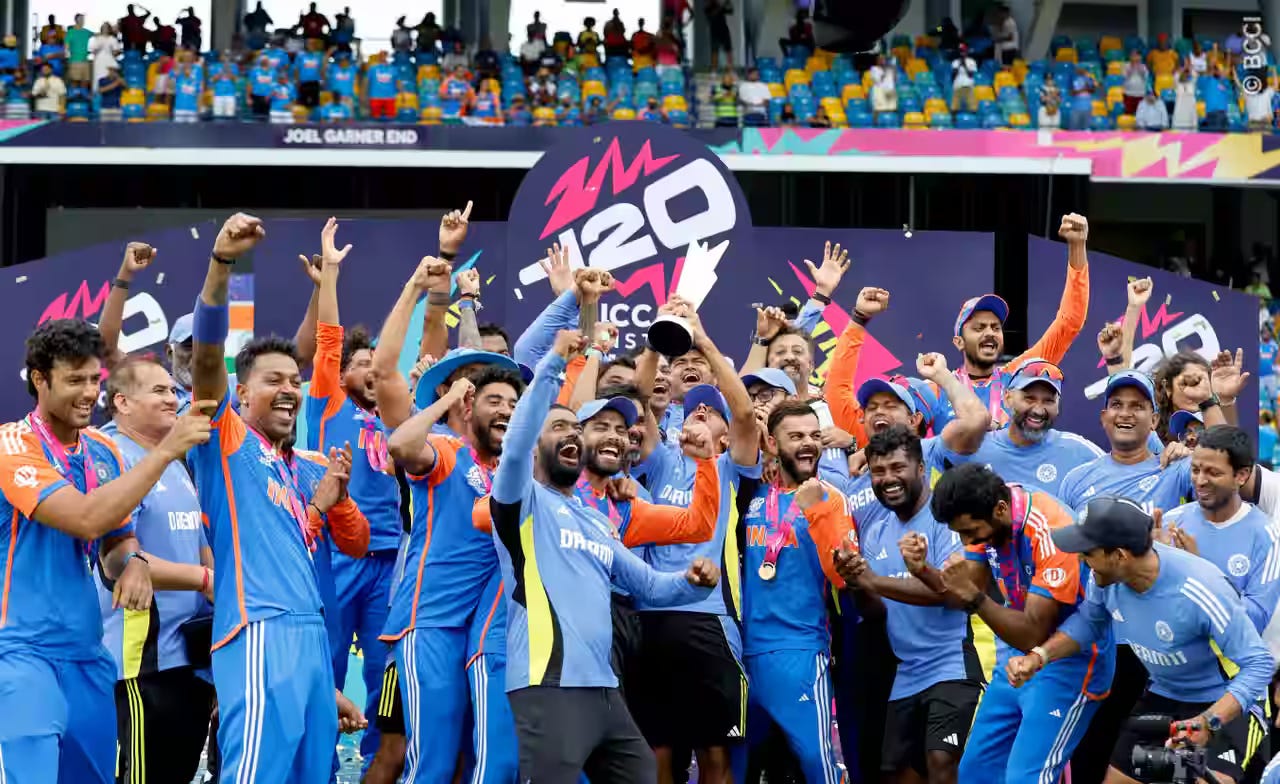
Image credits: BCCI
All that preparation about treating it as just another match? It was gone the moment Surya took that catch. And looking at Rohit thumping the ground, Hardik in tears, I realized maybe some matches aren’t meant to be treated like any other.
We also learn that we should try to always have belief and keep going. That for every 19th November 2023, there is also a 29th June 2024. That sometimes the losses we carry—the November 2023 finals, the years of semi-final heartbreaks—aren’t just burdens. They’re part of what makes the victories matter. And maybe that’s why we keep watching, keep hoping, keep getting attached despite our best efforts not to.
Thank you for reading!
Until next time,
Sagar